DOMENICO CIAFFONE: Music, time and what remains (EN)

In Other Words
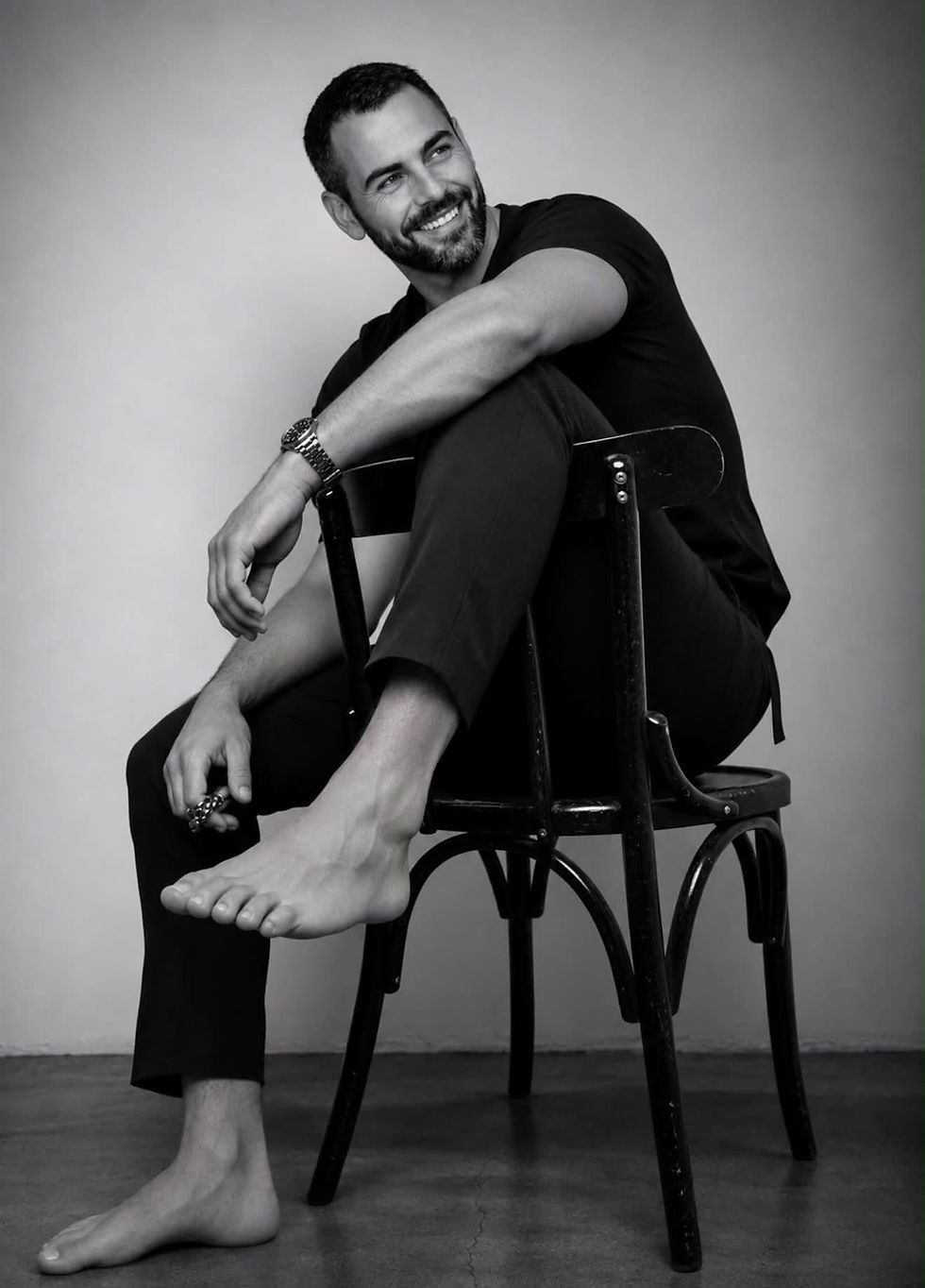
Music changes with time. The way we listen to it changes, the way we create it changes, and even the place it occupies in our lives changes. Some passions do not need to become our only profession in order to accompany us, transform us and tell part of the story of who we are.
It is from this perspective that we meet Domenico Ciaffone for a new conversation in In Other Words: a dialogue about music, certainly, but also about time, about the experiences that change the way we see things, and about that part of ourselves that continues to look for a space in which to express itself.
IOW — When did you realize that music would not simply be a passion, but something that would become part of your professional life? What were your beginnings like?
DC — Music came into my life almost naturally. First through listening, then through DJ sets, nights out, discovering sounds and, finally, through production.
My beginnings were driven by curiosity and passion. I did not have a major structure behind me or a path mapped out in advance. There was simply someone who deeply loved music and wanted to understand what lay behind those sounds that could move so many people.
Then came the first major events, the encounters, the collaborations and the productions.
Music, however, has never been my main profession. I have always worked for a company and have had a professional life outside music. Perhaps that is precisely what has made my relationship with music even more authentic.
I have never needed music to make a living. I have needed music to live emotionally.
They are two very different things.
I have always had these two parallel lives: during the day, work, responsibility and everyday life. At night, whenever I could, music.
And I believe it is precisely this dual dimension that has shaped the Domenico Ciaffone I am today.
IOW — Your career has developed through very different experiences and moments. Looking back, which stages do you consider truly decisive in your professional evolution?
DC — I cannot point to just one.
My evolution has been made up of many small moments that, taken together, have built the path.
There were the first nights, the first times performing in front of a large audience, encounters with people who taught me something, collaborations and music production.
And there were difficult moments too.
Because a career does not grow only when everything works. Sometimes you grow much more when something breaks.
Over time, I have learned that you should not be in a hurry to become something. You need the patience to become yourself.
Today I look back on my journey with gratitude because it has not been linear. There have been highs and lows, moments when everything seemed possible and others when everything seemed to have come to a standstill.
But every stage has left me with something.
IOW — How would you define your musical identity today? What does a track, a sound or a project need to have for you to truly feel that it is “yours”?
DC — My musical identity is not a word.
I do not think, “Now I have to make house,” or “Now I have to make techno.”
I think about the emotion I want to create.
Genre is a category. Emotion is something much bigger.
When I produce, I always look for a balance between energy and feeling. I like it when a track works on the dance floor but, at the same time, leaves something inside you.
For me, a track needs to have a soul.
You can have the perfect sound, the perfect mix, the perfect production, but if the emotion is missing, the most important thing is missing.
When I listen to one of my own productions and can recognize myself in it, then I know I am on the right path.
IOW — You experienced the Italian house and techno scene first-hand, as well as major events such as the one in Genoa with more than 20,000 people. How has that scene changed over the years, and what do you think remains of the spirit of that era?
DC — I was fortunate enough to experience a period when electronic music had a very physical relationship with its audience.
I think about major events such as the one in Genoa, with more than 20,000 people, and even today I find it difficult to describe what it felt like.
When you are standing in front of a crowd that large, you understand that music can become something collective.
It is no longer simply you performing and them listening. You become one.
Over the years, everything has changed. Technology has transformed the way music is produced, the way artists communicate and the way an artist’s career is experienced. Today, a musician can reach the entire world through a screen.
But there is something no technology can replace: the physical presence of people in front of you.
That feeling of sharing the same night, the same sound, the same energy.
IOW — Who is Domenico Ciaffone? Beyond the DJ, the producer and the music professional, who is Domenico today?
DC — This is probably the most difficult question.
Because when you take away the DJ, the producer, the stage, the records and everything other people see, what remains is a person.
I am simply Domenico.
A man who works, who has responsibilities, who has experienced wonderful moments and very difficult ones. A person who still loves to feel deeply.
Today, above all, I am someone who has learned to value the things that are real.
I am no longer interested in appearances. I am interested in leaving something behind.
A feeling. A memory. An emotion.
I have always believed that behind every artist there is a person. And I do not want to hide that person.
IOW — In your life, you have also had to face a very difficult period related to illness. How much did it change the way you see life, time, people and even music? Is there a “before” and an “after” for you?
DC — Yes. There is a before and there is an after.
When you go through something that calls your life into question, your priorities suddenly change.
There are things you used to waste time on that afterwards no longer carry any weight.
And there are others that you once took for granted and that suddenly become precious.
An ordinary day.
A phone call.
Someone beside you.
A hug.
A song.
Time.
Above all, time.
I realized that time is the most precious thing we have and, at the same time, the thing we tend to waste the most.
Illness taught me not to keep postponing life.
Music changed too.
Before, I thought a lot about the result. Today, I think much more about what I want to convey.
When I create, I also carry with me what I have lived through: my fears, my joys, my losses, my desires.

IOW — When you create music, where does the creative process usually begin? Do you start with an emotion, a sound, a specific idea, or do you let the music itself show you the direction?
DC — Very often, I start without knowing where I want to end up.
It might be a sound, a bassline, a melody, a rhythm.
Sometimes a small intuition is enough.
Then I start building.
And at a certain point, something happens: the track stops being a project and begins to develop an identity of its own.
It is as if the music starts speaking to you.
I try to listen to it.
Because that is the most beautiful part of production: you can start out thinking you want to tell one story and end up telling another.
Music brings out things you may not even have planned to say.
IOW — Your journey also includes your collaboration with Alfredo Sulla. How did your artistic relationship begin, and what does each of you bring to the project?
DC — My collaboration with Alfredo began, first and foremost, with a human connection.
For me, that is essential.
You can be working with an incredibly talented musician, but if there is no personal understanding, sooner or later the collaboration comes to an end.
When you work with another person, you have to be willing to listen. You cannot assume that your idea is always the right one.
What is interesting is seeing what happens when two different sensibilities come together.
Each person brings their own experience, their own way of listening to and interpreting music.
And from that meeting, something can emerge that neither of you would have created in quite the same way alone.
IOW — Let’s talk about Baila conmigo. How did the track come about and what does it represent for you? Is there a particular story behind its creation?
DC — Baila conmigo came from the desire to rediscover a simple emotion.
Movement.
Lightness.
Sensuality.
The desire to feel good.
After so many experiences, and after periods when life forced me to stop and reflect, I wanted to create something that also spoke about life.
Baila conmigo is an invitation.
Not simply an invitation to dance.
It is an invitation to let yourself go. To live in the moment. To stop constantly thinking about what has been or what will be.
Baila conmigo ultimately means, “Come and live this moment with me.”
We live in a world where we are constantly focused on the future. Music, on the other hand, can bring us back to the present.
IOW — Where is Domenico Ciaffone today, artistically and personally? What are you working on, and is there a project, a new production or a future direction that you would particularly like to highlight?
DC — Today I find myself at a very particular moment in my life.
On the one hand, I continue my professional career at the company, which has always been part of my life. On the other, there is music, which I have never abandoned.
Work has taught me discipline, responsibility and organization. Music has taught me freedom, emotion and courage.
Today, these two parts coexist within me.
I am working on new projects and new productions, but above all I am trying to give continuity to a path that I do not want to build in a hurry.
I do not want to produce music simply to remain visible.
I want every new production to have something to say.
I do not know where this path will lead. And for the first time in my life, I do not feel the need to know.
I only know that I will continue making music for as long as I have something to tell.
A space that remains
Music has occupied different spaces in Domenico Ciaffone’s life, without necessarily following a linear path and without becoming the only possible definition of his journey.
And yet, it has remained.
It has remained through moments of lightness and through the most difficult ones, through major events and the hours devoted to production, through collaborations and everything that is still waiting to take shape.
Today, that space remains open. Not as a destination already written, but as a place to return to whenever there is still something left to tell.
Perhaps it is not necessary to know where the next track will lead. Sometimes it is enough to still have something to say and to choose not to stop listening to it.
IOW

Comentarios